Monday, 22 February 2016

CONNECTIVE TISSUE PROPER

AREOLAR TISSUE

*It contains air in its space, hence it is called areolar connective tissue or spongy tissue.
*it contains following types of cells having specific function-

  1. Mast cell-it is small spherical cell scattered in matrix..
                         it secretes following types of chemical-
     (A) Heparin-natural anticoagulant.
     (B) Histamin- vasodialator, Antiallergic
     (C) Serotonin-vasoconstricter  


     2. Histiocytes cell-it is phagocytic cell, it engulfs disease causing.
    
    3.Plasma cell-it is small spherical cell,which secretes antibodies.

    4. Fibroblast cells- these cells forms animal fibrous tissue. it is divided into two groups-
             (A)white fibrous/collagen/inelastic tissue- unbranched collagen protein. 


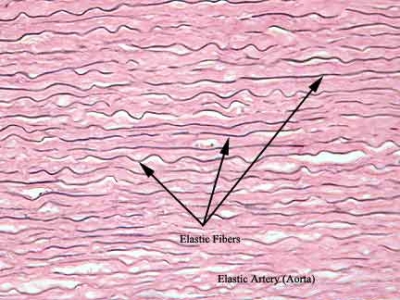
             (B)yellow fibrous/ elastic tissue-thin and branched and made up of elastin protein

FIBROUS TISSUE

* these connective tissue contains fibroblast cells and animal's fibre
*fibrous connective tissue classified into two groups-
  1. White fibrous connective tissue-it is made up of white fibre, e.g.- tendon.
  2. Yellow fibrous connective tissue- it is made up of yellow fibre. e.g.- ligament
ADIPOSE TISSUE

* it contains fat and fat forming cells.
*it is further classified into two groups-
      White adipose tissue
      Brown adipose tissue.
*in children, brown adipose tissue is present in excess amount , hence children less suffer from cold.
*brown adipose tissue contain excess amount of mitochondria and very less amount of ATPs.
*as age increases, brown adipose changes into white adipose tissue.
*Blubber- it is thick pad of adipose tissue found in blue whale.
*Hump-it is found in camel and ox, it is accumulation of adipose tissue.

RETICULAR CONNECTIVE TISSUE

*it is thin thread like structure of reticulin protein.
*reticulin protein is generally store in lymphatic tissue. e.g. lymph, vermiform appendix, spleen.


CONNECTIVE TISSUE

*It helps in connection and binding of cells, tissue and different organ.
*it helps in transportation of nutrients.
*it gives mechanical support to body.
*it also helps in transportation of hormones and enzymes.
*it helps in hearing(malleus, incus, stapes)
*it also helps in production of sound.
*WHARTSON JELLY - an undifferentiated connective tissue, which is only found in umbilical cord of foetus.
*MESENCHYME- undifferentiated connective tissue found everywhere except umbilical cord.
*CLASSIFICATION OF CONNECTIVE TISSUE-


Sunday, 21 February 2016

STRATIFIED EPITHELIUM (COMPOUND EPITHELIUM)

*cellls arranged in more than one layer.
*basal layer of the tissue are either cuboidal or columnar , never squamous, so it is further classified into three types on the basis of cells present on its upper surface-

  1. Compound squamous epithelium/ pavement
  2. Compound columnar epithelium
  3. Compound squamous epithelium
1. Compound squamous epithelium-this type of epithelium contains, squamous cells on free surface, it is further classified into two group on the basis if Keratin protein.

#Compound keratinised squamous epithelium-it contains keratin protein, hence it is hard and dead. e.g.-epidermis of skin.

#Compound non-keratinised squamous epithelium-it does not contain keratin protein, so it is relatively soft. it is present at all opening of the body which communicate with environment like mouth, anus ,nasal opening,ear opening, urinogenital opening.


2. Compound cuboidal epithelium-this type of epithelium contains cuboidal cells on free surface.
e.g.-testis, ovary

3.Compound columnar epithelium-this type of epithelium contains columnar cells on its free surface.
e.g.- epiglottis, gullet, larynx,pharynx,oesophagus(all parts are of food track).


SPECIAL TYPE OF EPITHELIAL TISSUE

A. Pseudo-stratified epithelium- cells arranged in single layer, but it apopears like arranged in more than one layer. e.g.-it is found near pharynx.

B. Transitional epithelium-these epithelium do not contain basement membrane. in this type of epithelium cells are arranged in 4-5 layers, and cells of each layer have different function. e.g.- urethra, urinary bladder.

Saturday, 20 February 2016

SIMPLE EPITHELIAL TISSUE (EPITHELIUM)

*first animal tissue found in coelentrata.
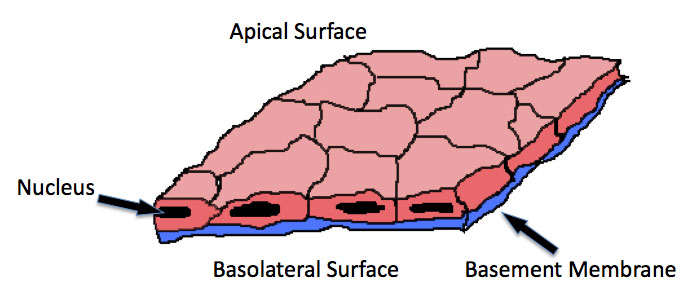
*cells arranged in single or more than one layers, but the upper end of the layer is always free, means not covered.
*presence of basement membrane, which is made up of gylcoprotein and polysaccharide.
*epithelium divides throughout life.
*cell of epithelium are avascular
*Types of  epithelium on the basis of layer of the cell-

  1. Simple epithelium
  2. Compound/ Stratified epithelium
1. Simple epithelium-cells are arranged in single layer. it is further classified into three different group-

  • Simple squamous epithelium/ Pavement
  • Simple cuboidal epithelium/ Germinal epithelium
  • Simple columnar epithelium
Simple squamous epithelium- cells are arranged like tiles or scales of fish.
-it contain very less quantity of matrix.
-cells are smaller in size.
-nucleus is at center of the cell.
-distribution- (a) Pericardium (covering of heart)- parietal pericardium, visceral pericardium, pericardial fluid.
                      (b)Bowman's capsule-it is a part of nephron in kidney.
                      (c)Pleura of lungs- it is covering.

Simple cuboidal epithelium- it contain very less quantity of matrix.
-it is also known as germinal epithelium.
-thyroid follicle of thyroid gland are made up of cuboidal epithelium.

Simple columnar epithelium- cells are column like or row like.
-nucleus present towards the base.
-it contain less quantity of matrix.

Modification of simple columnar epithelium
(1) Ciliated epithelium- presence of small hairy structure on free surface of the cell, called cilia.
-it performs specialised function.
-it present in neck of nephron.
-cilia of nephron helps in movement of filtrate from anterior end to posterior end.
- it is also found in alveoli of lungs.
-it also conduct egg in fallopian tube.

(2)Sensory epithelium- cells of columnar epithelium modified to receive stimulus.
-it is found in taste bud of tongue.
-it is also found in organ of corti.
-also present in rod and cones of retina of eye.
-schnederian membrane of nasal tube.

(3)Glandular epithelium- cells of columnar epithelium modified to form glands and gland specialised for secretion of substance.
               Types of glands on the basis of number of cells present in gland.-
#Unicellular glands- these gland contains only one cell. e.g.- goblet cell( found in intestine of human and secretes mucus), ebner's gland(present in tongue and secretes lipid digestive enzyme).

#Multicellular glands-these gland contain more than one cells. e.g.- salivary gland, ovary, testis, liver, pancreas,thyroid, pituitary gland, lacrymal gland, mammary gland, sweat gland, parotid gland etc

              Types of glands on the basis of transportation-
#Exocrine gland-it has duct to transport their product. e.g.-salivary gland, lacrymal gland, mammary gland, liver etc.

#Endocrine gland-these are duct less gland, they circulate their product through blood. e.g.- thyroid, pituitary,thymus etc.

#Heterocrine gland-in this type of gland one part has duct and another is ductless. e.g.- pancreas.

            Types of glands on the basis of mode of secretion-
#Holocrine gland-in this type of gland their total cytoplasm releases in the form of secretory material.e.g- sebaceous gland.

#Apocrine gland-in this type of gland, small amount of cytoplasm releases in the form of secretory product. e.g.-mammary gland.

#Merocrine gland-in this type of gland the secretory product releases through diffusion.e.g.- mammary gland.


ANIMAL TISSUES, INTRODUCTION

*group of cells having similar origin and function but their structure may or may not be similar , is commonly called TISSUE.
*study of tissue is called Histology.
*father and founder of Histology - Marcello Malpighi
*Matrix- it is secretory product of cell in tissue. The quantity of matrix and chemical composition varies in different cell.
*first of all tissue appeared in animals of phylum coelentrata.
*on the basis of function tissues are classified into four types-
  1. Epithelial tissue- FUNCTION- absorption, secretion, protection etc.
  2. Connective tissue- FUNCTION- connection, binding, joining, attachment etc.
  3. Muscular tissue- FUNCTION- contraction and relaxation, movement and locomotion.
  4. Nervous tissue- FUNCTION- to receive stimulus and transport the transport the stimuli from one place to another.


Wednesday, 17 February 2016

MAMMALIA CLASS, VERTEBRATA.

*these animals are warm blooded, hairy and have mammary or milk producing glands.
*there are about 4.000 species of mammals found in world.
*they are the only animals which nourish their young once with milk.
*sebaceous glands(oil gland) and sudoriferous glands(sweat gland) are present in the skin.
*teeth are heterodont and thecodont(embedded in the shocket of jaws). they develop twice in a life hence it is diphyodont
*they possess a muscular diaphragm dividing trunk into thorax and abdomen.
*mammals possess seven cervical vertebrae, except few.
*the skull is dicondylic.
*the heart is four chambered.
*the coelom is divided into four cavities- a pericardial cavity, two pleural cavities and an abdominal cavity.
*12 pair of cranial nerve.
*each consists of three parts,external, middle and internal. pinna is a part of external ear
*a copulatory organ is always present.
*fertilization is internal.
*except egg laying animal they are viviparous.
*sub-class are Prototheria and Theria
*e.g.-kangaroo, opossum, human etc
OPOSSUM


HUMAN


KANGAROO


Tuesday, 16 February 2016

AVES-CLASS, VERTEBRATA

*about 9000 species of aves are found
*they are warm blooded animal.
*they have bipeadal feather.
*their fore-limbs are modified into wings.
*the hind limbs are adapted for perching, walking or swimming.
*only preen gland(oil gland) present on tail, and no other gland present on skin.
*Ostrich and parrot lack oil glands
*upper and lower jaws modified into beak,which lack teeth
*legs bear horny epidermal skin.
*respiration occurs in lungs.
*syrinx produces voice in birds not larynx.
*heart is four chambered, sinus venosus is absent.
*renal portal system is very much reduced.
*kidney is metanephric, which directly drain uric acid into cloca through ureter. urinary bladder is absent
*Reha americana (South American Ostrich ) is the only bird which has urinary bladder.
*cerebrum, cerebellum and optic lobes are developed organ of brain.
*birds have 12 pair of cranial nerves.
*bones are pneumatic,means they have air cavity to reduce weight , which helps in flying.
*skull is monocondylic.
*female has well developed single left ovary and oviduct.if right ovary and oviduct are present then they are non-functional.
*sexual dimorphism is found in many birds.
*fertilization is internal
*birds are oviparous, means they lay eggs.
*e.g.-Ostrich, Kiwi. Penguins, Parrot, Duck

OSTRICH


KIWI


PENGUINS