Showing posts with label BIOLOGICAL CLASSIFICATION. Show all posts

Sunday, 13 December 2015

QUESTION AND ANSWER OF THE CHAPTER BIOLOGICAL CLASSIFICATION

1. DISCUSS HOW CLASSIFICATION SYSTEM HAVE UNDERGONE SEVERAL CHANGES OF A PERIOD OF TIME?

ANSWER: From early period Many attempts had done to classify living organism. ARISTOTLE was the first who classified plants on the simple morphological character i.e. herb,  shrubs,  and  tree .  and animals as red blood and no blood.
         After Aristotle , CAROLUS LINNAEUS classified living inti two categoriesi.e. Plantae  and Animalia. this classification continued till very recent time, but the classification did not distinguish between prokaryotes( false nucleus) and eukaryotes(true nucleus), unicellular and multicellular, autotrophic and heterotrophic.
        Hence it was found inadequate system, and a new system was needed.
       THE RECENT AND MOST ACCEPTED CLASSIFICATION SYSTEM IS FIVE KINGDOM CLASSIFICATION SYSTEM BY R.H.WHITTAKER.
2. STATE TWO ECONOMICALLY IMPORTANT USES OF
   (A) HETETOTROPHIC BACTERIA.
   (B) ARCHAEBACTERIA

ANSWER: heterobacteria- Lacto bacillus is used in converting milk into curd.
                                          - bacteria are used to produce antibiotic.
                   archaebacteria- Methanogens are used ase methane gas producer.
                                          - extraction are being explored, including the use of acidophiles, in a                                                         process known as bioleaching.

3.WHAT IS THE NATURE OF CELL WALL IN DIATOMS?

ANSWER: the cell wall of diatoms are made up of two thin overlapping shell,which fixes as soap box. silica are embedded in its cell wall, hence its wall is indestructible.

4.FIND OUT WHAT DO THE TERMS 'ALGAL BLOOM' OR 'RED-TIDES' SIGNIFY.

ANSWER: algal bloom or red tides is the result of rapid multiplication of the dinoflagellates -Gonyaulax. this dinoflagellates is red in colour and spread over  the sea, which appears red coloured sea, and the tides also appears red.

5.HOW ARE VIROIDS DIFFERENT FROM VIRUSES?

ANSWER: viroids are smaller than virus.
                  it has only free RNA and no DNA.
                  it lacks protein coat.
                  the RNA of viroids are of low weight

6.DESCRIBE BRIEFLY THE FOUR MAJOR GROUP OF PROTOZOA.

ANSWER:1.  Amoeboid protozoans- they live in fresh water, marine water, moist soil
                                         they have pseudopodia e.g.- amoeba
                                         they have silica shell on surfacee.g.- entamoeba

2.Flagellated protozoans-they are either free living or parasitic.
                                         they have flagella e.g. - Trypanosoma

3.Ciliated protozoans-they are aquatic and actively moving organism.
                                    they have thousand of cilia. e.g.- paramoecium

4.Sporozoans- this includes diverse organism.
                        Plasmodium is it example which is cause very dangerous disease nemed Malaria.
7.PLANTS ARE AUTOTROPHIC. CAN YOU THINK OF SOME PLANTS THAT ARE PARTIALLY HETEROTROPHIC?

ANSWER:yes some plants like Cuscuta  is parasite, Bladderwort and Venus fly trap are insectivorous. they are not autotrophes.

8.WHAT DO THE TERM PHYCOBIONT AND MYCOBIONT SIGNIFY?

ANSWER: phycobiont and mycobiont are respectively algal and fungal component of Lichen.
phycobiont make food for mycobiont and mycobiont  absorbe minerals and water for phycobiont.

9. GIVE A COMPARATIVE ACCOUNT OF THE CLASSES OF KINGDOM FUNGI UNDER THE FOLLOWING:
  A. MODE OF NUTRITION
  B. MODE OF REPRODUCTION.

ANSWER:
                                      mode of nutrition                                             mode of reproduction

phycomycetes               mostly parasite                                               asexual-zoospores                                                                                                                                                    aplanospores
                                                                                                             sexual-zygospores

ascomycetes                  saprophtyic                                                    asexual-conidia
                                      parasite                                                           sexual-ascospore                                                                 coprophilous

basidiomycetes             parasite                                                           vegetative-fragmentation                                                                                                                            no sexual reproduction
                                                                                                                     but fusion of somatic cell

deuteromycetes            saprophyte                                                       asexual-conidia                                                                  parasite


10. WHAT ARE THE CHARACTERISTIC FEATURES OF EUGLENOIDS?

ANSWER: *majority lives in fresh and stagnant water.
*they have protein rich layer called Pellicle, so its body is flexible.
* they don't have cell wall.
*they are autotroph in presence of sun light and heterotroph in absence of sun light.
*pigments of euglenoids are same as in higher plants.
*example ; Euglena

 11.GIVE A BRIEF ACCOUNT OF VIRUSES WITH RESPECT TO THEIR STRUCTURE AND NATURE OF GENETIC MATERIAL?

ANSWER: 
VIRUS- viruses are non-cellular organism. they have inert crystalline structure outside the living                       body.
                 -when they invert living cell they take over the machinery of the host cell to replicate                            themselves and kill the host cell.
                 -D.J.IVANOWSKY(1892) named virus means poisonous fluid.
                 -M.W.BEIJERINEK(1898) discovered TMV(tobacco mosaic virus)
                 -W.M.STANLEY (1935) showed that virus could be crystallised and crystals consist                              largely of proteins.
                 -viruses are obligate parasites.
                 -it contain genetic material DNA or RNA.
                 -Bacteriophages or bacterial viruses are usually have double strand DNA.
                 -the protein coat of virus of capsid, made up of small subunits called capsomeres protect                       the nucleic acid.
                 -these capsomere are arranged in helical or polyhedral geometric form.
               

Saturday, 12 December 2015

VIRUS, VIROIDS AND LICHEN

* virus, viroids and lichen are acellular organism which have no place in five kingdom classification.
* VIRUS- viruses are non-cellular organism. they have inert crystalline structure outside the living                       body.
                 -when they invert living cell they take over the machinery of the host cell to replicate                            themselves and kill the host cell.
                 -D.J.IVANOWSKY(1892) named virus means poisonous fluid.
                 -M.W.BEIJERINEK(1898) discovered TMV(tobacco mosaic virus)
                 -W.M.STANLEY (1935) showed that virus could be crystallised and crystals consist                              largely of proteins.
                 -viruses are obligate parasites.
                 -it contain genetic material DNA or RNA.
                 -Bacteriophages or bacterial viruses are usually have double strand DNA.
                 -the protein coat of virus of capsid, made up of small subunits called capsomeres protect                       the nucleic acid.
                 -these capsomere are arranged in helical or polyhedral geometric form.
                 -disease caused by virus are AIDS, mumps,small pox etc.
                                                                                                                                           
BACTERIOPHAGE
TMV


*VIROIDS- T.O.DIENER discovered a new infectious agent smaller than virus
                   - it was a free RNA
                   - it lacked the protein coat.
                   - RNA of viroid had low molecular weight.


* LICHENS -  association of algae and fungus is calledlichen.
                      - algal component is called phycobiont and fungal component as mycobiont.
                      - algae prepare food for fungus and fungus provide shelter and absorb mineral and                                 water from soil.


                                                                                                                                page-17           

Friday, 11 December 2015

DEUTEROMYCETES


COLLETOTRICHUM


TRICHODERMA


ALTERNARIA


*commonly known as imperfect fungi.
*deuteromycetes reproduce only by the mean of asexual spore called conidia.
*the mycelium is septate and branched.
*some are saprophytic, some are parasitic and some are decomposers of litter which helps in mineral cycle.
*e.g.- Alternaria, Colletotrichum, Trichoderma.


                                                                                                                                               page-16

BASIDIOMYCETES

                                                                  AGARICUS
* mushrooms, bracket fungi and puffballs are common basidiomycetes.
* they grow in soil, on logs, tree stumps and in living plant bodies as parasite.e.g.-rust and smut.
*the mycelium is branched and septate.
*vegetative reproduction by fragmentation is common in this class.
*asexual spore and sexual organ are absent.
*fusion of two different strain of somatic cell cause plasmogamy which give rise to basidium.
*basidium produces four basidiospore by karyogamy and meiosis.
* the basidia are arranged in fruiting bodies called basidiocarps.
*e.g.-Agaricus (mushroom), Ustilago (smut), Puccinia(rust fungus)


 USTILAGO

                                                                      PUCCINIA
 
                                                                                                                                         page-15

ASCOMYCETES

*commonly known as sac fungi.
*they may be unicellular-yeast, or multicellular- penicillium.
* they are saprophytic, decomposure,parasitic or coprophilous(growing on dung).
*mycelium is branched and septate.
*asexual spore conidia produced on special mycelium called conidiophores.
*sexual spores are called ascosporeswhich are produced in asci.
*these asci are arranged in different types of fruiting bodies called ascocarps.
*morels and buffles are edible fungi.
*e.g.- Aspergillus, Claviceps, Neurospora


ASPERGILLUS


  CLAVICEPS

                                                                        NEUROSPORA


                                                                                                                                         page-14

PHYCOMYCETES

* they are found in aquatic habitats or in decaying wood in moist place or as obligate parasite on plants.
*mycelium is aseptate and coenocytic.
*asexual reproduction by motile zoospore and non-moile aplanospore.
*sexual reproduction takesplace by zygospore,it may be isogamous,anisogamousor oogamous.
*e.g.- Mucor, Rhizopus, Albugo

 MUCOR


RHIZOPUS


                                                                       ALBUGO


                                                                                                                                      page-13

FUNGI KINGDOM

* Fungus are heterotrophes,they depend on dead and decayed food, hence they are saprophytes. some are parasites, some are symbionts e.g.- Lichen( live in association with algae) and some are mycorrhiza( association with roots of higher plants).
* fungus are cosmopolitan and occur in air, water, soil  and on animals and plants body.
* they prefer to grow in warm and humid area.
* only yeast are unicellular.
*fungus are filamentous.
*their bodies consist of long slender thread like structure called hyphae.
*the cell wall of fungi is composed of chitin and polysaccharides.
* all types of reproduction are seen in fungus, such as
         >vegetative reproduction-by fragmentation , fission, and budding.

         >asexual reproduction-by spore formation called conidia or sporangiospores or zoospores.

         >sexual reproduction-by oospore, ascospore and basidiospore.

*sexual reproduction involves following steps-
         -fusion of protoplasm between two motile and non-motile gametes called plasmogamy.         -fussion of two nuclei called karyogamy.         -meiosis in zygote resulting in haploid spores.

* dikaryon- in ascomycetes and basidiomycetes, at the time of fusion the two nuclei comes together and makes dikaryon. this phase is called dikaryophase..
* fungus are divide into various classes, some are-
    1. phycomycetes
    2.ascomycetes
    3.basidiomycetes
    4.deuteromycetes

                                                                                                                               page-12

PROTOZOANS

*they are heterotrophes and live as predator or parasite.
*they are of four major types:-
1. Amoeboid protozoans- they live in fresh water, marine water, moist soil
                                         they have pseudopodia e.g.- amoeba
                                         they have silica shell on surfacee.g.- entamoeba

2.Flagellated protozoans-they are either free living or parasitic.
                                         they have flagella e.g. - Trypanosoma

3.Ciliated protozoans-they are aquatic and actively moving organism.
                                    they have thousand of cilia. e.g.- paramoecium

4.Sporozoans- this includes diverse organism.
                        Plasmodium is it example which is cause very dangerous disease nemed Malaria.

                                                                                                                             page-11

SLIME MOULDS

*they are saprophytes(depend on dead and decay food).
* in favourable condition they aggregate and forms plasmodium.
* in unfavourable condition it forms fruiting body and forms spores, which lasts for several years.


                                                                                                                                       page-10

EUGLENOIDS

* majority lives in fresh and stagnant water.
*they have protein rich layer called Pellicle, so its body is flexible.
* they don't have cell wall.
*they are autotroph in presence of sun light and heterotroph in absence of sun light.
*pigments of euglenoids are same as in higher plants.
*example ; Euglena

                                                                                                                                          page-9

DINOFLAGELLATES

* these are mostly marine
* they are photosynthetic.
*they may be red, green ,blue, brown, yellow etc.
*most of them have two flagella, one is longitudinal and another is transverse.
* Gonyaulax divide rapidly and forms red tides on sea.
* they release toxic substances.


                                                                 RED SEA

                                                                                                                         page-8

CHRYSOPHYTES

*they live in both fresh and marine water.
*they are microscopic and float with water current.
*they are mostly photosynthetic.
*diatoms,golden algae(desmids)   are its examples.
*diatoms have silica cell wall.
* accumulation of silica in its habitat forms diatomaceous earth, which is used as polishing, filtering oil, in syrup.
*diatoms are producers of ocean.


                                                                                                                                page-7

PROTISTA KINGDOM

* single cell eukaryotes are placed under this protista,but the limitation of this kingdom is not defined.
* it has well defined nucleus and membrane bound organelles.
*some protista have cilia or flagella.
*they reproduce by both mean i.e. sexually and asexually.
* Chrysophytes, Slime moulds, Euglenoids, Dinoflagellates , Protozoans are comes under protista.

                                                                                                                            page-6

Thursday, 10 December 2015

EUBACTERIA


CYNOBACTERIA

                                                                           MYCOPLASMA

* It is also called as true bacteria
* they are characterized by the presence of rigid cell wall.
* they are of various types.
* CYNOBACTERIA- it is also called as blue-green algae. it has chlorophyll 'a' ,hence it is photosynthetic autotroph.
* the CNB may be unicellular, colonial, filamentous, marine or terrestrial.
* the colonies are generally surrounded by gelatinous sheath.
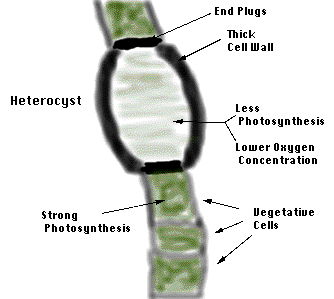
* some of these organism fix nitrogen in specialised cell called heterocysts e.g. Nostoc, Anabaena.
*
CHEMOSYNTHETIC AUTOTROPHIC BACTERIA oxidise various inorganic substances such as nitrate,nitrite and ammoniaand use the released energy for their ATP production.
* chemosynthetic bacteria play a great role in recycle of nitrogen, phosphorus, sulphur, iron ect.
* HETEROTROPHIC BACTERIA are mostly found in nature.
* the majority are important decomposure.
* some bacteria are useful for human being like lactobacillus (convert milk into curd) and some are pathogenic cause disease.
* bacteria reproduce mainly by fission.
* in unfavourable condition bacteria produces spores.
* bacteria also reproduce by a sort of sexual reproduction by adopting a primitive DNA of another bacteria
* MYCOPLASMA are the smallest living known,which can survive without oxygen too. it has lack of cell wall.


                                                                                                                              PAGE-5

ARCHAEBACTERIA

They are different from bacteria living around us because they can survive in extreme salty area(HALOPHILES), hot spring(THERMOACIDOPHILES) and marshy area(METHANOGENES). they have different cell wall structure. methanogenes live in gut of ruminants animal

HALOPHILES


                                                                                  page-4 

MONERA KINGDOM

Bacteria are the sole members of this kingdom. it is found everywhere and also in extreme habitat,such as deep ocean, snow, hot water etc.
      It is of four types on the basis of structure:-
1. cocci- round shape
2. bacilli- rod shape
3. spirillum- spiral shape
4. vibrio- comma shape
* some bacteria are photoautotrophic
* some are chemoautotrophic
* some are heterotrophic
* archaebacteria-live in harsh habitat
*eubacteria-they are true bacteria


                                                                                                                page-3

FIVE KINGDOM CLASSIFICATION SYSTEM

It was proposed by R.H.WHITTAKER in 1969. he devided organism on the basis of cell structure,thallus organisation,mode of nutrition, reproduction and phylogenetic relationship.
             Five kingdom classification system has separated  unicellular and multicellular, autotrophic and heterotrophic, fungi and green plant, eukaryotes and prokaryotes and many other organism with different chatacters.

     
                                                                                                                     page-2

BIOLOGICAL CLASSIFICATION

From early period Many attempts had done to classify living organism. ARISTOTLE was the first who classified plants on the simple morphological character i.e. herb,  shrubs,  and  tree .  and animals as red blood and no blood.
         After Aristotle , CAROLUS LINNAEUS classified living inti two categoriesi.e. Plantae  and Animalia. this classification continued till very recent time, but the classification did not distinguish between prokaryotes( false nucleus) and eukaryotes(true nucleus), unicellular and multicellular, autotrophic and heterotrophic.
        Hence it was found inadequate system, and a new system was needed.
       THE RECENT AND MOST ACCEPTED CLASSIFICATION SYSTEM IS FIVE KINGDOM CLASSIFICATION SYSTEM BY R.H.WHITTAKER.

                                                                                                                              page-1