Thursday, 10 December 2015

EUBACTERIA


CYNOBACTERIA

                                                                           MYCOPLASMA

* It is also called as true bacteria
* they are characterized by the presence of rigid cell wall.
* they are of various types.
* CYNOBACTERIA- it is also called as blue-green algae. it has chlorophyll 'a' ,hence it is photosynthetic autotroph.
* the CNB may be unicellular, colonial, filamentous, marine or terrestrial.
* the colonies are generally surrounded by gelatinous sheath.
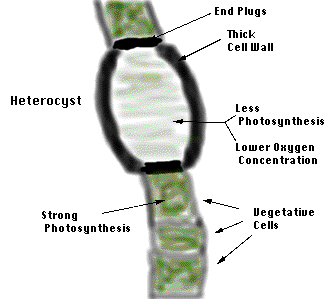
* some of these organism fix nitrogen in specialised cell called heterocysts e.g. Nostoc, Anabaena.
*
CHEMOSYNTHETIC AUTOTROPHIC BACTERIA oxidise various inorganic substances such as nitrate,nitrite and ammoniaand use the released energy for their ATP production.
* chemosynthetic bacteria play a great role in recycle of nitrogen, phosphorus, sulphur, iron ect.
* HETEROTROPHIC BACTERIA are mostly found in nature.
* the majority are important decomposure.
* some bacteria are useful for human being like lactobacillus (convert milk into curd) and some are pathogenic cause disease.
* bacteria reproduce mainly by fission.
* in unfavourable condition bacteria produces spores.
* bacteria also reproduce by a sort of sexual reproduction by adopting a primitive DNA of another bacteria
* MYCOPLASMA are the smallest living known,which can survive without oxygen too. it has lack of cell wall.


                                                                                                                              PAGE-5

ARCHAEBACTERIA

They are different from bacteria living around us because they can survive in extreme salty area(HALOPHILES), hot spring(THERMOACIDOPHILES) and marshy area(METHANOGENES). they have different cell wall structure. methanogenes live in gut of ruminants animal

HALOPHILES


                                                                                  page-4 

MONERA KINGDOM

Bacteria are the sole members of this kingdom. it is found everywhere and also in extreme habitat,such as deep ocean, snow, hot water etc.
      It is of four types on the basis of structure:-
1. cocci- round shape
2. bacilli- rod shape
3. spirillum- spiral shape
4. vibrio- comma shape
* some bacteria are photoautotrophic
* some are chemoautotrophic
* some are heterotrophic
* archaebacteria-live in harsh habitat
*eubacteria-they are true bacteria


                                                                                                                page-3

FIVE KINGDOM CLASSIFICATION SYSTEM

It was proposed by R.H.WHITTAKER in 1969. he devided organism on the basis of cell structure,thallus organisation,mode of nutrition, reproduction and phylogenetic relationship.
             Five kingdom classification system has separated  unicellular and multicellular, autotrophic and heterotrophic, fungi and green plant, eukaryotes and prokaryotes and many other organism with different chatacters.

     
                                                                                                                     page-2

BIOLOGICAL CLASSIFICATION

From early period Many attempts had done to classify living organism. ARISTOTLE was the first who classified plants on the simple morphological character i.e. herb,  shrubs,  and  tree .  and animals as red blood and no blood.
         After Aristotle , CAROLUS LINNAEUS classified living inti two categoriesi.e. Plantae  and Animalia. this classification continued till very recent time, but the classification did not distinguish between prokaryotes( false nucleus) and eukaryotes(true nucleus), unicellular and multicellular, autotrophic and heterotrophic.
        Hence it was found inadequate system, and a new system was needed.
       THE RECENT AND MOST ACCEPTED CLASSIFICATION SYSTEM IS FIVE KINGDOM CLASSIFICATION SYSTEM BY R.H.WHITTAKER.

                                                                                                                              page-1

ORGANISM WITH THEIR TAXONOMIC CATEGORIES


                                                                                                                                                 page-28

Wednesday, 9 December 2015

QUESTION AND ANSWER OF NCERT BOOK,LESSON-THE LIVING WORLD. (CLASS 11TH)

1. WHY ARE LIVING ORGANISM CLASSIFIED?

ANSWER: We can not study each and every living organism,hence for our convenience we classify them. all animals and plants are related to each other, some are useful and some are dangerous, so, it is very necessary to aware about surroundings.

OR WE DESCRIBE AS

From early period Many attempts had done to classify living organism. ARISTOTLE was the first who classified plants on the simple morphological character i.e. herb,  shrubs,  and  tree .  and animals as red blood and no blood.
         After Aristotle , CAROLUS LINNAEUS classified living inti two categoriesi.e. Plantae  and Animalia. this classification continued till very recent time, but the classification did not distinguish between prokaryotes( false nucleus) and eukaryotes(true nucleus), unicellular and multicellular, autotrophic and heterotrophic.
        Hence it was found inadequate system, and a new system was needed.
       THE RECENT AND MOST ACCEPTED CLASSIFICATION SYSTEM IS FIVE KINGDOM CLASSIFICATION SYSTEM BY R.H.WHITTAKER.

2.WHY ARE THE CLASSIFICATION SYSTEM CHANGING EVERY NOW AND THEN?

ANSWER: Modification is needed everywhere. if new discovered classification system is better than the earlier and more convenient then change is needed.

3.WHAT DIFFERENT CRITERIA WOULD YOU CHOOSE TO CLASSIFY PEOPLE THAT YOU MEET OFTEN?

ANSWER: I would choose his or her language, physique and nature to classify people we meet often.

4.WHAT DO WE LEARN FROM IDENTIFICATION OF INDIVIDUAL AND POPULATION?

ANSWER: Identification of individual means specific character found in that individual, and identification of population means group of morphologically same individuals.

5.WRITE THE BOTANICAL NAME OF MANGO.

ANSWER: Mangifera indica

6.
DEFINE A TAXON. GIVE SOME EXAMPLES OF TAXA AT DIFFERENT HIERARCHICAL LEVEL.

ANSWER: All organism are categorized into various category, there category are scientifically called as taxa.species, genus,family,order, class etc are different level of taxa.

7.WRITE THE CORRECT SEQUENCE OF TAXONOMICAL CATEGORY.

ANSWER: species--genus--family--order--class--phylum/division--kingdom.

8. GROUP DISCUSSION ON SPECIES.

9.DEFINE THE TERM.
  (A)PHYLUM  (B)CLASS (C)FAMILY (D)ORDER (E) GENUS

ANSWER: (A) Phylum-  it the second highest category of taxa.
e.g. chordata, animal like fishes,amphibians,reptiles , birds along with mammals constitute this phyla.
the main character of this phyla is presence of notochord and dorsal hollow neural system.                   (B)Class-This category includes related orders.
e.g. Mammalia- carnivora-tiger,lion,cat,dog
                         herbivora- monkey,gibbon,gorilla
                  (C)Family- It is the next level of taxa. it is also known as collection of closely related genus. it has less number of similarities as compare of genus and species. families are characterized by both vegetative and reproductive features.
e.g. solanaceae- solanum
                          petunia
                          datura
       felidae-       panthera
                          felis
       cancidae-    cancidae                 (D)Order-Order is a higher category. it may also called as collection of closely related family
e.g.-1. plant family- polynomial(mainly based on floral character)-convolvulaceae
                                                                                                     -solanaceae
     2.  animal family-carnivora- felidae
                                              -cancidae
                (E)Genus-          Genus is the second least level of taxa. It comprises a group of similar species Or we say that the genera are aggregates(collection) of closely related species.
e.g.-Solanum tuberosum     - potato
       Solanum lycopersicum - tomato
       Solanum melongena     - brinjal
all are of similar genera but they are different things because they have different species.


10. HOW IS KEY HELPFUL  IN    IDENTIFICATION AND CLASSIFICATION OF AN ORGANISM?

ANSWER:     Key is a taxonomical aid, which based on the contrasting characters called couplet. it represent the choice between the two option i.e. acceptance of one and rejection of another as its results.
each statement in the key is called LEAD.
11. ILLUSTRATE THE TAXONOMICAL HIERARCHY WITH SUITABLE EXAMPLES OF A PLANT AND AN ANIMAL.

ANSWER:* Kingdom- Plantae-   plants
                                    Animalia-animals
                  * phylum(for animals)- Chordata ,   division(for plants)-Magnoliophyta
   
                  *class- Mammalia

                  *order-polymoniales

                  *family- Solanaceae

                  *genus- panthera

                  *species- leo