*first animal tissue found in coelentrata.
*cells arranged in single or more than one layers, but the upper end of the layer is always free, means not covered.
*presence of basement membrane, which is made up of gylcoprotein and polysaccharide.
*epithelium divides throughout life.
*cell of epithelium are avascular
*Types of epithelium on the basis of layer of the cell-
-it contain very less quantity of matrix.
-cells are smaller in size.
-nucleus is at center of the cell.
 -distribution- (a) Pericardium (covering of heart)- parietal pericardium, visceral pericardium, pericardial fluid.
(b)Bowman's capsule-it is a part of nephron in kidney.
(c)Pleura of lungs- it is covering.
Simple cuboidal epithelium- it contain very less quantity of matrix.
 -it is also known as germinal epithelium.
-thyroid follicle of thyroid gland are made up of cuboidal epithelium.
Simple columnar epithelium- cells are column like or row like.
-nucleus present towards the base.
-it contain less quantity of matrix.
Modification of simple columnar epithelium
 (1) Ciliated epithelium- presence of small hairy structure on free surface of the cell, called cilia.
-it performs specialised function.
-it present in neck of nephron.
-cilia of nephron helps in movement of filtrate from anterior end to posterior end.
- it is also found in alveoli of lungs.
 -it also conduct egg in fallopian tube.
(2)Sensory epithelium- cells of columnar epithelium modified to receive stimulus.
-it is found in taste bud of tongue.
-it is also found in organ of corti.
-also present in rod and cones of retina of eye.
-schnederian membrane of nasal tube.
(3)Glandular epithelium- cells of columnar epithelium modified to form glands and gland specialised for secretion of substance.
Types of glands on the basis of number of cells present in gland.-
#Unicellular glands- these gland contains only one cell. e.g.- goblet cell( found in intestine of human and secretes mucus), ebner's gland(present in tongue and secretes lipid digestive enzyme).
*cells arranged in single or more than one layers, but the upper end of the layer is always free, means not covered.
*presence of basement membrane, which is made up of gylcoprotein and polysaccharide.
*epithelium divides throughout life.
*cell of epithelium are avascular
*Types of epithelium on the basis of layer of the cell-
- Simple epithelium
- Compound/ Stratified epithelium
- Simple squamous epithelium/ Pavement
- Simple cuboidal epithelium/ Germinal epithelium
- Simple columnar epithelium
-it contain very less quantity of matrix.
-cells are smaller in size.
-nucleus is at center of the cell.
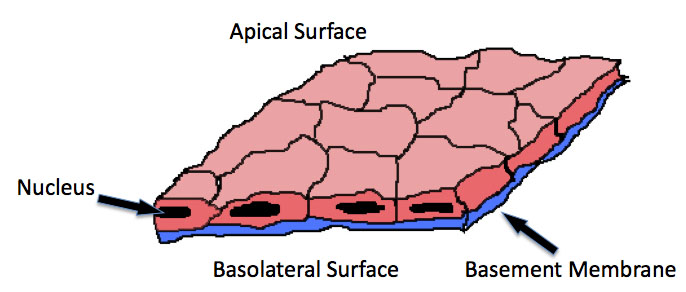
(b)Bowman's capsule-it is a part of nephron in kidney.
(c)Pleura of lungs- it is covering.
Simple cuboidal epithelium- it contain very less quantity of matrix.
-thyroid follicle of thyroid gland are made up of cuboidal epithelium.
Simple columnar epithelium- cells are column like or row like.
-nucleus present towards the base.
-it contain less quantity of matrix.
Modification of simple columnar epithelium

-it performs specialised function.
-it present in neck of nephron.
-cilia of nephron helps in movement of filtrate from anterior end to posterior end.
- it is also found in alveoli of lungs.
(2)Sensory epithelium- cells of columnar epithelium modified to receive stimulus.
-it is found in taste bud of tongue.
-it is also found in organ of corti.
-also present in rod and cones of retina of eye.
-schnederian membrane of nasal tube.
(3)Glandular epithelium- cells of columnar epithelium modified to form glands and gland specialised for secretion of substance.
Types of glands on the basis of number of cells present in gland.-
#Unicellular glands- these gland contains only one cell. e.g.- goblet cell( found in intestine of human and secretes mucus), ebner's gland(present in tongue and secretes lipid digestive enzyme).
#Multicellular glands-these gland contain more than one cells. e.g.- salivary gland, ovary, testis, liver, pancreas,thyroid, pituitary gland, lacrymal gland, mammary gland, sweat gland, parotid gland etc
Types of glands on the basis of transportation-
#Exocrine gland-it has duct to transport their product. e.g.-salivary gland, lacrymal gland, mammary gland, liver etc.
#Endocrine gland-these are duct less gland, they circulate their product through blood. e.g.- thyroid, pituitary,thymus etc.
#Heterocrine gland-in this type of gland one part has duct and another is ductless. e.g.- pancreas.
Types of glands on the basis of mode of secretion-
#Holocrine gland-in this type of gland their total cytoplasm releases in the form of secretory material.e.g- sebaceous gland.
#Apocrine gland-in this type of gland, small amount of cytoplasm releases in the form of secretory product. e.g.-mammary gland.
#Merocrine gland-in this type of gland the secretory product releases through diffusion.e.g.- mammary gland.


